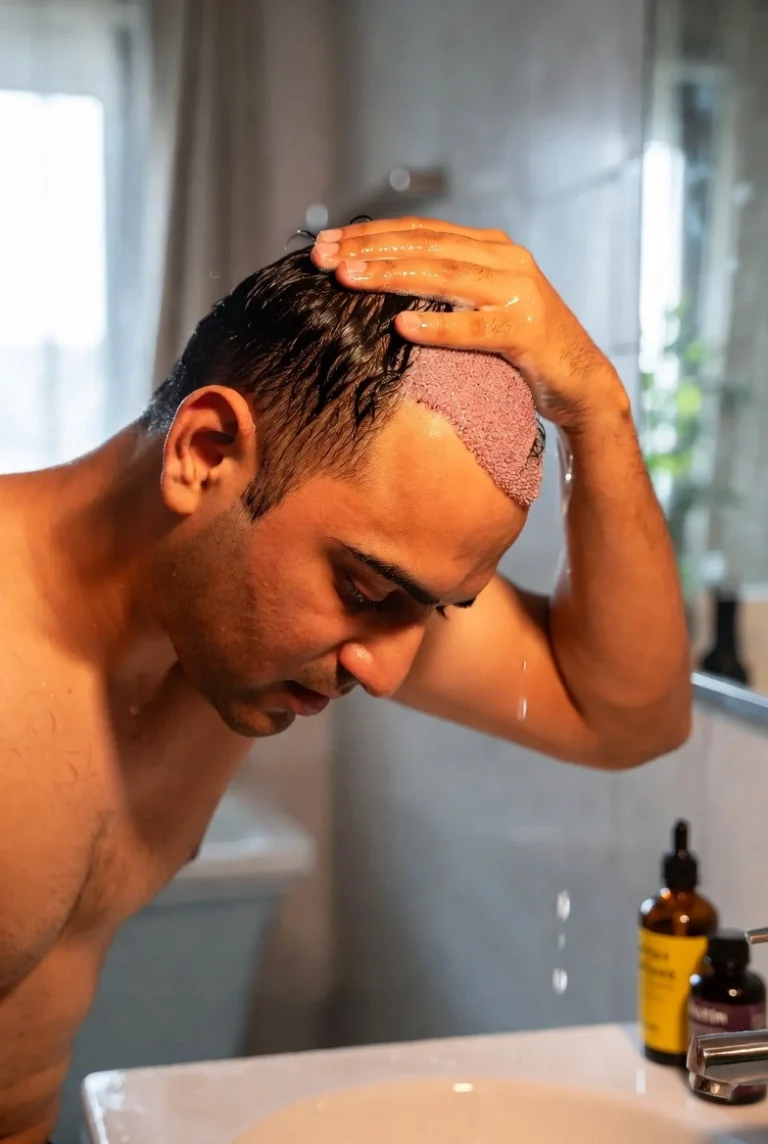
In the world of hair restoration, the highest compliment a patient can receive is, “You didn’t have a transplant, did you?” The ultimate goal of modern surgery is not just to grow hair, but to create a hairline so flawless, so inherently you, that the procedure itself becomes invisible. Gone are the days of the tell-tale “pluggy” look or the low, uniform hairline that screams surgical intervention. Today, the most natural hairlines created by surgeons are masterpieces of medical artistry, a seamless blend of science and aesthetics that can fool even the most discerning eye.
But what does it take to craft a hairline that defies detection? It is a meticulous process that involves far more than simply planting hairs. It requires a deep understanding of facial architecture, the patience to recreate nature’s randomness, and the wisdom to plan for a lifetime of aging.
The Blueprint: Age, Asymmetry, and the “Mature” Hairline
The journey to a natural result begins not in the operating room, but on paper (or a digital tablet) during the consultation phase. One of the most critical mistakes a surgeon can make—and a cornerstone of the best work—is designing a hairline that is appropriate for the patient’s age and future hair loss .
Leading experts like Dr. Paul McAndrews in Los Angeles emphasize that a hairline must look natural not just on the first day of growth, but for decades to come . A low, straight, juvenile hairline might look tempting to a 25-year-old patient, but if his hair loss progresses behind it, he will be left with a strange island of hair on an otherwise bald forehead. This is why approximately 50% of Dr. McAndrews’ practice is dedicated to corrective surgeries for patients who received hairlines that were too low or poorly designed .
A truly natural hairline is often slightly higher and features gentle temporal recessions. This “mature” design is conservative, ensuring that the patient will look balanced and normal as they age, and it maximizes the perceived density of the transplanted hair .
Furthermore, nature abhors a straight line. The most natural hairlines are intentionally irregular and slightly asymmetrical. As noted by experts, it is a common error to make a hairline too uniform; it should have a soft, saw-tooth, or zigzag pattern at the leading edge . One side of the hairline is often shaped just a little differently than the other, a subtle nod to the natural asymmetry found in every human face .
The Architectural Details: Graft Selection and Hair Direction
Once the blueprint is drawn, the real artistry begins with the placement of the grafts themselves. A natural hairline does not start thick; it transitions gradually from forehead to full density. This is achieved by using a specific distribution of follicular units:
-
The Leading Edge (0-5mm): The very front row of the hairline is composed exclusively of single-hair grafts . These fine, soft hairs create a delicate transition that mimics the way natural hair thins out at the temples and forehead. If a surgeon uses a two-hair graft at the very front, it can look unnaturally thick and “pluggy,” immediately betraying the surgery .
-
The Transition Zone: Immediately behind the front edge, the surgeon places a mix of one and two-hair follicular units. This creates a soft, imperceptible gradient of density.
-
The Forelock and Central Density: Deeper into the hairline, larger grafts containing three or even four hairs are concentrated. This provides the visual weight and fullness that frames the face, without the harshness at the front .
Perhaps even more important than the number of hairs per graft is the direction and angle at which they are placed. Hair does not grow straight out of the scalp. In a natural state, it emerges at specific angles, generally pointing forward and lying flatter (more acute to the scalp) as it approaches the hairline .
At the very front, the hair should emerge almost horizontally, parallel to the ground . This allows it to gently cascade over the forehead, creating a soft shadow and a natural look. If the angle is even slightly off—if the hair sticks straight out or grows in the wrong direction—it can be nearly impossible to fix and will always look unnatural . Master surgeons like Dr. Yael Halaas in NYC describe this process as strategically planning for “flow, texture, and coverage,” ensuring the new hair harmonizes seamlessly with any existing strands .
The Masters of the Craft: Surgeons Who Set the Standard
While many clinics claim to create natural results, a select group of surgeons are globally recognized for their peerless artistry in hairline design. Their work represents the pinnacle of what is possible in hair restoration.
Dr. Paul J. McAndrews (Los Angeles, CA) is a towering figure in the field, one of only two surgeons in the world to have served as President of both the International Society of Hair Restoration Surgery (ISHRS) and the American Board of Hair Restoration Surgery (ABHRS) . His philosophy is rooted in restraint and long-term planning. He is famous for his conservative, ethical approach, often advising patients against overly low hairlines to prevent them from looking unnatural in the future . His meticulous technique, where he performs only one surgery per day and personally places each graft, results in transplants that celebrity stylists call “completely undetectable” .
Dr. Yael Halaas (New York, NY) , a double board-certified facial plastic surgeon, brings a unique perspective to hair restoration. Her background in facial aesthetics means she designs a hairline to complement the specific proportions of a patient’s face, ensuring it restores balance and harmony . Her use of refined micro-graft methods and pioneering research in regenerative therapies like exosomes represents the cutting edge of achieving not just density, but overall hair vitality .
Dr. Pukpinya Jangjetriew (Bangkok, Thailand) is a leading voice in emphasizing the technical precision required for natural results. At Hairtran Clinic, she stresses that recreating the hair’s natural direction is the hardest element to correct if done wrong . Her team focuses on the “gradient” of thickness, using single-hair grafts at the front and carefully managing the donor area to ensure the extraction sites themselves don’t create a patchy look . This commitment to detail has made her a board-certified specialist with international training.
Dr. Jason Dudas (Bosley Medical Group) , a board-certified plastic surgeon, represents the fusion of surgical precision and artistic vision. With over a decade of experience and nearly a thousand procedures, he is renowned for his work in hairline lowering and creating transformative, natural results. His background in stem cell research and facial plastic surgery gives him a deep understanding of tissue handling and aesthetics, ensuring that the hairline not only looks natural but heals beautifully .
The Final Verdict
The most natural hairline ever created by a surgeon is one you would never question. It is the result of a deep respect for biology, a keen eye for design, and a humble understanding that the goal is not to improve upon nature, but to restore it. By focusing on irregularity, appropriate angles, single-hair front lines, and a long-term vision for aging, these master surgeons perform a kind of magic: they make hair reappear, and make the scalpel disappear.
About the Author