Red light therapy, also known as photobiomodulation (PBM), has emerged as a powerful, science-backed tool for health optimization. From reversing skin aging to accelerating muscle recovery and even supporting brain health, the therapeutic application of light is transforming how we approach wellness . However, not all light is created equal. To harness the full potential of PBM, one must understand the critical role of wavelength optimization. The two most prominent contenders in the therapeutic spectrum are 630nm (red light) and 810nm (near-infrared light). While both target the mitochondria to stimulate cellular energy production, their distinct properties dictate their ideal applications. This article provides a detailed comparison of 630nm and 810nm light to help you choose the right “medicine” for your specific health goals.
The Common Foundation: Targeting Cytochrome C Oxidase
Before diving into the differences, it is essential to understand the shared mechanism of action. Both 630nm and 810nm light are effective because they are absorbed by a specific photoreceptor within our cells: cytochrome c oxidase (CCO) . This enzyme is a critical component of the mitochondrial respiratory chain, responsible for cellular respiration and the production of adenosine triphosphate (ATP)—the energy currency of the cell.
In states of stress, injury, or aging, a molecule called nitric oxide can bind to CCO and inhibit its function, slowing down ATP production. Photobiomodulation works by delivering photons of specific wavelengths that dissociate this inhibitory nitric oxide, restoring electron transport and significantly boosting ATP synthesis . This increase in cellular energy then fuels a cascade of beneficial effects, including reduced inflammation, enhanced tissue repair, and improved blood flow . The question is not if these wavelengths work, but where they work best.
The 630nm Wavelength: The Dermatological Powerhouse
Light in the 630nm range falls within the visible red spectrum. It is sometimes referred to as “cold red light” and is the wavelength most commonly associated with LED masks and panels designed for skin health .
Key Characteristics
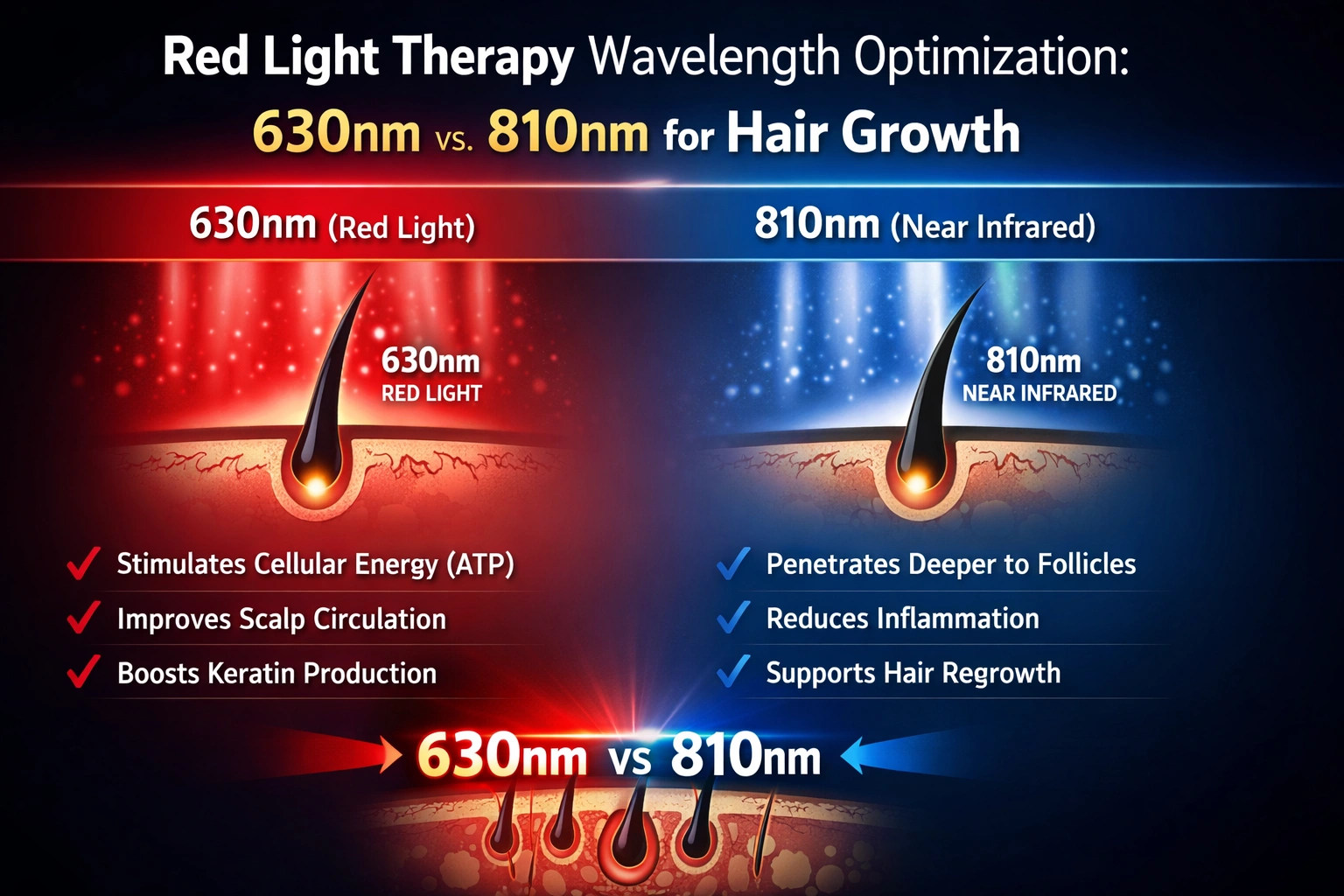
Penetration Depth: Shallow. 630nm light is optimally absorbed by the skin and the cells within the superficial layers, including fibroblasts and sebaceous glands .
Primary Targets: Skin, scalp, and surface-level tissues.
Primary Applications
Skin Rejuvenation and Anti-Aging: This is where 630nm light shines brightest. Because it targets the dermis, it is highly effective at stimulating collagen and elastin production. A 2023 clinical study using a 630nm LED mask demonstrated profound anti-aging effects. Over three months of twice-weekly use, participants experienced a 38.3% reduction in crow’s feet wrinkle depth, a 24.8% improvement in facial sagging, and a remarkable 47.7% increase in dermal density . These structural changes lead to firmer, smoother, and more youthful-looking skin.
Wound Healing: 630nm light excels at accelerating the repair of superficial wounds and cuts. Research confirms its ability to promote the proliferation and migration of fibroblasts—the cells responsible for building new connective tissue .
Sebum Regulation: The 630nm wavelength has been shown to significantly reduce sebum (oil) production in the skin. In the same 2023 study, sebum levels dropped by over 70% after three months of treatment, making it a potential therapeutic option for acne-prone skin .
The 810nm Wavelength: The Deep Tissue Specialist
Moving into the invisible, near-infrared (NIR) spectrum, 810nm light offers a different set of advantages. Its primary superpower is its ability to penetrate deeply into the human body, passing through skin, bone, and into internal organs .
Key Characteristics
Penetration Depth: Deep. 810nm light can penetrate several centimeters into tissue. Studies have demonstrated that 810nm light at sufficient power can deliver biologically beneficial fluence through 3 cm of tissue, including the skull and brain .
Primary Targets: Muscles, joints, tendons, nerves, and the brain.
Primary Applications
Neurological and Cognitive Support: The ability of 810nm light to penetrate the skull makes it a focus of research for traumatic brain injury (TBI) and neurodegenerative conditions. By reaching brain tissue, it can improve cerebral blood flow, support mitochondrial function in neurons, and reduce neuroinflammation .
Deep Muscle and Joint Recovery: For athletes or those dealing with chronic joint pain (like osteoarthritis), 810nm is the wavelength of choice. It penetrates through the superficial layers to reach deep muscles, ligaments, and the interior of joints, accelerating recovery and reducing deep-seated inflammation .
Systemic Effects: By modulating blood flow through the release of nitric oxide, 810nm light can have vasodilatory effects, potentially improving circulation throughout the body .
Head-to-Head Comparison: 630nm vs. 810nm
To visualize the differences more clearly, the table below summarizes the distinct profiles of these two therapeutic wavelengths.
Feature 630nm (Red Light) 810nm (Near-Infrared)
Visibility Visible Red Light Invisible Infrared
Penetration Depth Shallow (Skin, scalp, surface tissue) Deep (Muscle, joints, bone, brain)
Primary Mechanism Fibroblast stimulation, collagen production Mitochondrial activation in deep tissue, vasodilation
Optimal Applications Wrinkle reduction, skin firming, acne, superficial wound healing Brain health, deep muscle recovery, joint pain, nerve regeneration
Clinical Evidence 38% reduction in wrinkles, 47% increase in dermal density 2.9% of surface energy penetrates 3cm of tissue; benefits in TBI
A Note on Efficacy: Similar Outcomes for Some Applications
Interestingly, while their depths differ, a 2022 comparative study on diabetic wound healing found that both 630nm and 810nm LEDs produced similar outcomes in promoting cell proliferation and migration . This suggests that for certain applications—particularly those involving general tissue repair and fibroblast activity—both wavelengths can be effective, albeit potentially at different tissue depths. The key takeaway is that context matters. For a surface wound, 630nm is efficient; for a damaged nerve buried deep in tissue, 810nm is essential.
The Principle of the Biphasic Dose Response
When optimizing your use of red light therapy, wavelength is only half the equation. Both 630nm and 810nm light are subject to the Arndt-Schulz law, or the biphasic dose response. This principle states that too little light has no effect, while too much light can inhibit the positive biological response . Therefore, adhering to recommended treatment times and irradiance (power density) levels is crucial to staying within the “therapeutic window” and avoiding photoinhibition.
Conclusion: Choosing the Right Light for Your Goal
In the debate between 630nm and 810nm, there is no single “winner.” Instead, the optimal wavelength depends entirely on your therapeutic target.
If your goal is aesthetic, focused on improving skin texture, reducing wrinkles, or managing acne, 630nm red light is the optimized, evidence-backed choice.
If your goal is recovery from deep muscle injuries, alleviating joint pain, or supporting cognitive function, the deep-penetrating power of 810nm near-infrared light is non-negotiable.
For many seeking whole-body wellness, a device that combines both wavelengths offers the most versatile solution, allowing you to harness the surface-level rejuvenation of 630nm and the deep-tissue healing of 810nm in one comprehensive protocol. As research continues to evolve, one thing remains clear: when it comes to photobiomodulation, precision—in wavelength, dose, and duration—is the key to unlocking its full regenerative potential.
About the Author