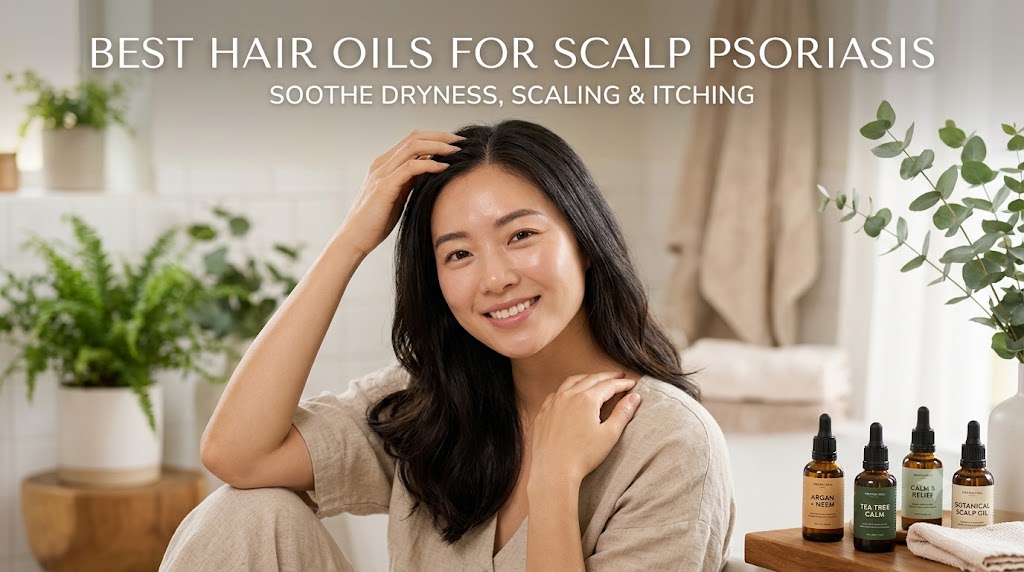
Best Hair Oils for Scalp Psoriasis: What to Buy for Dryness, Scaling and Itching
Short answer: The “best” hair oil for scalp psoriasis depends on what you are trying to do. For simple dryness and tightness, lightweight jojoba or squalane-based oils are reasonable adjuncts. For thick scaling, a keratolytic medicated product (salicylic acid or coal tar preparation) combined with a topical corticosteroid is what dermatology consensus actually supports—not a cosmetic oil alone. For itch and inflammation, no over-the-counter hair oil replaces prescription anti-inflammatory treatment.
Three key points before you buy:
- Oils are comfort tools, not psoriasis treatments. No cosmetic hair oil cures scalp psoriasis. The evidence-based first-line treatment is topical corticosteroids, often combined with vitamin D analogues.
- Some oils feed the yeast that worsens flaking. Coconut oil, argan oil, castor oil, and shea butter are lipid-rich and may feed Malassezia, a yeast implicated in seborrheic dermatitis and scalp irritation. Patch-test first and stop if flaking worsens.
- “Natural” does not mean safe for inflamed skin. Fragrance, essential oils, and botanical extracts can trigger contact dermatitis on a compromised scalp barrier.
Affiliate Disclosure
This article contains affiliate links. If you purchase through these links, we may earn a commission at no extra cost to you. This does not influence our evidence-based assessment. We do not recommend products we cannot verify, and we clearly separate cosmetic oils from medicated treatments.
Medical Disclaimer
This content is for educational purposes only and is not a substitute for professional medical advice. Scalp psoriasis requires individual assessment. Do not start, stop, or change any treatment without consulting a qualified healthcare provider.
Is Hair Oil Safe for Scalp Psoriasis?
Short answer: Sometimes, with caveats. Oil can soften scales and reduce tightness, but it can also worsen flaking if you choose the wrong oil or apply it to broken skin.
What Oil Can and Cannot Do
A well-chosen oil can:
- Soften thick, adherent scales so they lift more gently
- Reduce the sensation of tightness and dryness between washes
- Create a temporary barrier against environmental irritation
Oil cannot:
- Replace topical corticosteroids or vitamin D analogues, which are the first-line treatments for scalp psoriasis according to a 2026 Delphi consensus of 53 dermatologists
- Reduce the underlying inflammation that drives psoriasis
- “Detox” the scalp or “cure” flaking
The Malassezia Problem
Not all oils are neutral on a psoriasis-prone scalp. Malassezia is a yeast that lives on most adult scalps. When the scalp barrier is compromised or lipid composition changes, it can contribute to flaking and inflammation. Lipid-rich oils—including coconut, argan, castor, and shea—can feed this yeast in susceptible people. WebMD blogger and psoriasis patient Alisha Bridges notes that her dermatologist warned her some oils can “actually feed the yeast on your scalp that can cause dandruff.”
Practical rule: If your flaking worsens after starting an oil, stop it. Do not assume you need to “push through.”
Best Oils for Scalp Psoriasis: Buying Guide for Flakes, Dryness and Irritation
What to Look For
| Criterion | What Good Looks Like | Why It Matters |
|---|---|---|
| Oil type | Jojoba, squalane, or light mineral oil | Lower risk of feeding Malassezia than coconut/argan |
| Fragrance | Fragrance-free or very low fragrance | Fragrance is a common contact allergen on compromised skin |
| Essential oils | Avoid or minimal | Tea tree, peppermint, rosemary can irritate inflamed scalp |
| Added actives | Salicylic acid (keratolytic) if scaling is thick | Salicylic acid helps lift scales; consensus supports keratolytics with corticosteroids for severe scaling |
| Claim language | “Moisturizes,” “softens scales” | Honest cosmetic claims. “Treats psoriasis” is a red flag for unapproved drug claims |
Red Flags When Buying
- “Cures psoriasis” — No cosmetic oil can legally claim this, and no oil has been shown to cure psoriasis.
- High essential oil content — “100% pure tea tree” or “rosemary mint” blends may feel cooling but can irritate.
- Thick, heavy butters — Shea, cocoa butter, and castor oil sit on the surface and can trap scale and yeast.
- No full ingredient list — You cannot assess Malassezia risk or allergen potential without it.
Comparison: Best Soothing Oils vs. Medicated Scalp Treatments
Important: Medicated treatments are not cosmetic oils. They are drug products with specific indications, and some require a prescription. This table is for comparison only—not a recommendation to self-treat.
| Category | Product Type | Key Ingredient / Mechanism | Best For | Malassezia Risk | Evidence Level | Typical Cost Range |
|---|---|---|---|---|---|---|
| Lightweight soothing oil | Jojoba-based scalp oil | Jojoba esters; emollient | Dryness, tightness, gentle scale softening | Low | Cosmetic; limited clinical data | $12–$25 |
| Squalane-based oil | Squalane scalp serum | Squalane; non-comedogenic emollient | Sensitive, reactive scalp | Low | Cosmetic; anecdotal | $15–$30 |
| Keratolytic medicated | Salicylic acid 3–6% scalp solution | Salicylic acid; desquamating agent | Thick, adherent scaling | N/A (drug) | Supported by consensus for severe scaling with corticosteroids | $10–$25 |
| Anti-inflammatory medicated | Topical corticosteroid (e.g., betamethasone valerate) | Corticosteroid; anti-inflammatory | Redness, itching, active plaques | N/A (drug) | First-line per 2026 Delphi consensus | Prescription; varies |
| Combination medicated | Calcipotriol + betamethasone gel | Vitamin D analogue + corticosteroid | Initial and maintenance therapy | N/A (drug) | Consensus-supported for initial and maintenance | Prescription; varies |
Prices are NOT verified. Check current pricing and availability before purchasing.
Fragrance-Free Jojoba Scalp Oil
If your main complaint is tight, dry-feeling scalp between medicated treatments, a lightweight, fragrance-free oil is a reasonable comfort measure.
Why it stands out: Jojoba is chemically similar to human sebum and is less likely to feed Malassezia than coconut or argan oil.
What to verify: Full ingredient list, fragrance status, and whether the brand discloses Malassezia-friendly formulation.
Best Oils for Scalp Psoriasis: Product-by-Product Notes
1. Lightweight Jojoba Oil (For Dryness and Tightness)
Who it may suit: Adults with mild dryness and tightness who want a before-shampoo treatment that is unlikely to feed Malassezia.
What to know:
- Jojoba is a liquid wax ester, not a triglyceride oil, and is generally better tolerated on reactive scalps than coconut oil.
- Apply to dry scalp 20–30 minutes before washing. Do not apply to broken or bleeding skin.
- Patch-test behind the ear for 24–48 hours.
Limitations: No clinical trials support jojoba specifically for scalp psoriasis. It is a comfort measure, not an anti-inflammatory treatment.
2. Squalane Scalp Serum (For Sensitive, Reactive Scalp)
Who it may suit: People who react to plant oils and want a non-comedogenic, low-yeast-risk emollient.
What to know:
- Squalane is a saturated hydrocarbon that does not readily feed Malassezia.
- It is lightweight and less likely to leave a heavy residue that traps scale.
- Look for fragrance-free and essential-oil-free formulas.
Limitations: Cosmetic only. Does not replace medicated treatment.
Medicated Scalp Treatment to Discuss With Your Doctor
If scaling is thick and cosmetic oils have not helped, a keratolytic medicated product may be appropriate—but only with professional guidance.
Why it may be considered: Consensus supports keratolytics combined with corticosteroids for severe scaling.
What to verify: Active ingredient concentration, whether a prescription is required in your region, and compatibility with your current treatment.
Frequently Asked Questions
Final Verdict
The best “hair oil” for scalp psoriasis is not a single product—it is the right category for your symptom.
- For mild dryness and tightness: A fragrance-free, lightweight jojoba or squalane oil is a reasonable comfort measure. Low Malassezia risk, no drug claims.
- For thick scaling: A keratolytic medicated product (salicylic acid or coal tar) is more appropriate than a cosmetic oil. Discuss with a clinician, especially if you are also using a corticosteroid.
- For redness, itching, and active plaques: No over-the-counter oil substitutes for topical corticosteroid treatment. This is the dermatology consensus position.
What to verify before buying: Full ingredient list (fragrance? essential oils?), Malassezia-feeding potential, whether the product makes illegal disease-treatment claims, and current price.
Final CTA: If you are looking for a lightweight, fragrance-free option to use before washing, check current product details below.
References
González Cantero Á, et al. Management of scalp psoriasis: Updated treatment recommendations from a Delphi consensus of 53 dermatologists from AEDV Psoriasis Working Group. Actas Dermosifiliogr. 2026. PMID: 42926054.
Bridges A. How I Care For My Hair With Scalp Psoriasis. WebMD Blogs. September 2025.
Google Search Central. Help your readers find your site through preferred sources in Google Search.
Delhicious. Hair Oil for Scalp Psoriasis: How It May Soothe Irritation. August 2026.
VedicDerm (LinkedIn). Malassezia and scalp psoriasis: lipid environment and oil selection. 2025.
About the Author