
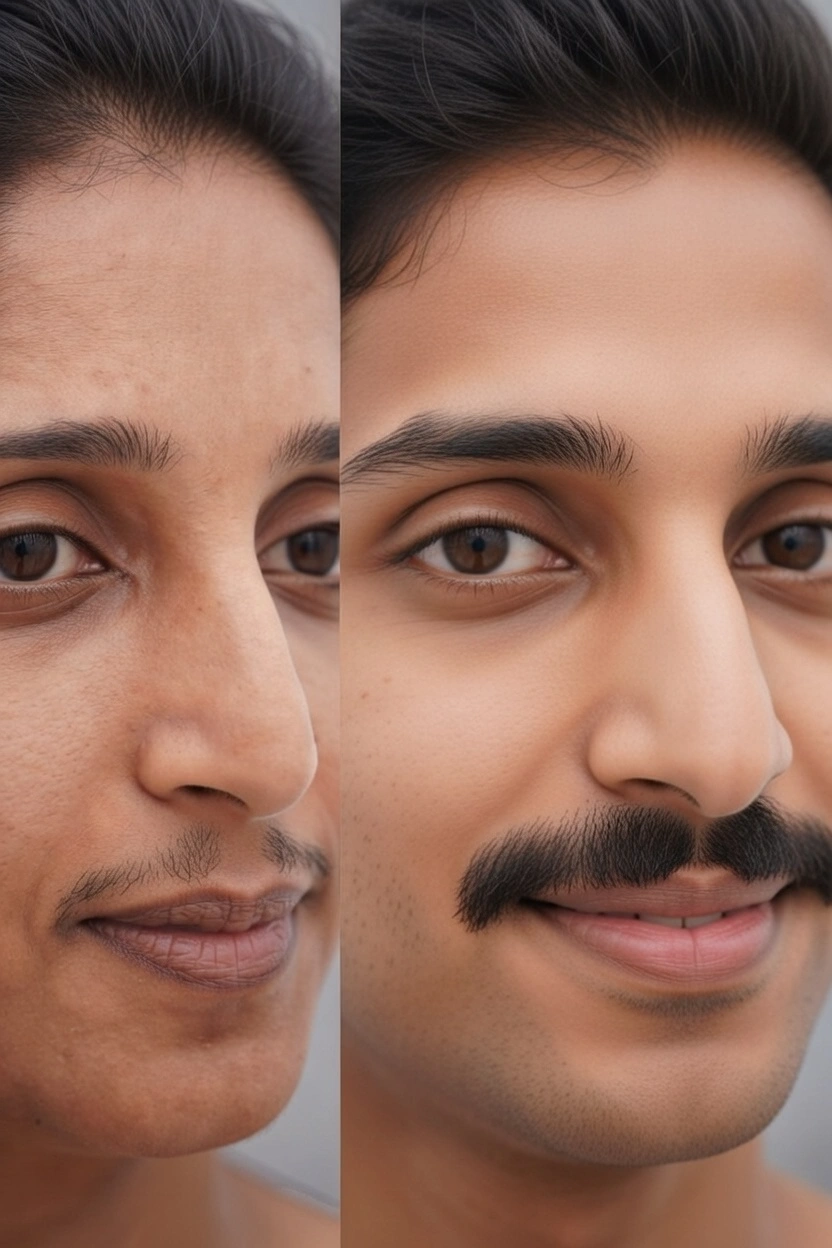
A well-groomed moustache is more than just facial hair—it’s a statement of style, masculinity, and personal identity. Yet many men struggle with patchy growth, thin areas, or scars that prevent them from achieving the look they desire. If you’ve ever wondered whether you can permanently fill in those gaps or restore a moustache lost to scarring, modern hair restoration techniques offer a solution.
This comprehensive guide explores everything you need to know about moustache hair transplants using Follicular Unit Extraction (FUE)—the gold standard technique in 2026. From understanding the procedure and recovery timeline to costs and post-operative care, consider this your roadmap to a fuller, more confident you.
What Is a Moustache Hair Transplant?
A moustache transplant is a specialized cosmetic procedure that involves relocating healthy hair follicles from a donor area—typically the back of the scalp—to the moustache region where hair is sparse, patchy, or absent . Unlike temporary solutions like growth serums or topical treatments, a transplant offers a permanent solution because the transplanted follicles retain their genetic resistance to balding .
Why Choose FUE for Moustache Transplantation?
Follicular Unit Extraction (FUE) has emerged as the preferred technique for facial hair restoration, and for good reason. Here’s why FUE stands out for moustache transplants:
Feature FUE Advantage
No Linear Scarring Individual follicles are extracted, leaving tiny dot-like scars that are virtually invisible, even with short hairstyles
Natural Results Allows meticulous placement matching the natural growth direction (15-40 degrees angle) of moustache hair
Minimally Invasive Performed under local anesthesia with quick recovery; most patients return to normal activities immediately
Precision Single-hair grafts can be used, essential for moustache area where hairs grow individually
No Shaving Required Advanced “long hair FUE” techniques allow harvesting without shaving donor areas, eliminating social downtime
Who Is a Good Candidate?
You may be an ideal candidate for a moustache transplant if you:
Have genetically sparse or patchy moustache growth
Want to cover scars from cleft lip repair, burns, injuries, or previous surgeries
Experience congenital absence of moustache hair
Are post-cancer treatment and lost facial hair due to chemotherapy or radiation
Are a transgender individual seeking to enhance masculine facial characteristics
Most surgeons recommend patients be at least 18 years old, as facial hair development typically matures after this age .
The Science Behind Moustache Transplants: What Research Shows
Recent clinical studies have validated the effectiveness of FUE for moustache reconstruction. A 2024 prospective randomized controlled trial compared FUE against older Follicular Unit Transplant (FUT) methods for correcting moustache alopecia in cleft lip patients. The results were compelling: the FUE group showed significantly better clinical outcomes at 1 month, 9 months, and 1 year post-procedure, with fewer adverse effects .
Breakthrough: Long Hair FUE for Moustache Reconstruction
In a groundbreaking 2025 case report published in the Journal of Cutaneous and Aesthetic Surgery, dermatologists successfully performed the first documented moustache reconstruction using long hair FUE with beard hair as the donor source . This innovative approach offers several advantages:
Immediate visualization of transplant outcomes during the procedure
No shaving of donor or recipient areas required
Enhanced patient comfort and elimination of social downtime
High satisfaction with results and excellent healing
The procedure used a phased extraction system (Zeus U Graft) to address the unique challenges of beard hair, including acute angulation and thicker shafts. Adjunctive therapies like platelet-rich plasma (PRP) and liposomal ATP were used to support graft retention .
The Moustache Transplant Procedure: Step by Step
Understanding what happens during the procedure can help ease any anxiety. Here’s a typical breakdown:
1. Consultation and Planning
Your journey begins with a thorough consultation where the surgeon:
Assesses your moustache area and discusses your aesthetic goals
Evaluates donor hair quality and density (usually from the scalp or lower neck beard)
Designs the moustache shape based on your facial symmetry and natural hair direction
Explains the number of grafts needed (typically 30-45 follicular units per square centimeter for good density)
2. Donor Hair Harvesting
On procedure day, the donor area is numbed with local anesthesia. Using an FUE device (like an 18-G punch system), the surgeon extracts individual follicular units. For moustache transplants, single-hair grafts are essential because moustache hairs naturally grow individually, unlike scalp hair which grows in clusters .
Advanced systems use a phased extraction technique:
Phase 1: Incision of epidermis with low-torque oscillations to glide along the hair shaft
Phase 2: Advancement through dermal tissue, releasing the follicle
Phase 3: Minimal dissection of perifollicular tissue to ensure graft integrity
3. Recipient Site Preparation
The surgeon creates tiny recipient slits in the moustache area using fine blades (typically 0.9 mm) . This step requires artistic precision because the angle and direction must match natural growth—usually 15-40 degrees, varying by location :
Near the midline: Direction angles downward and inward
Towards the corners: Direction shifts accordingly
4. Graft Implantation
Using a “double-forceps technique” with a “no-touch-to-root” approach, the surgeon carefully places each graft into the recipient sites . This minimizes mechanical stress and optimizes graft survival.
5. Adjunctive Therapies
Many clinics enhance outcomes with:
Platelet-Rich Plasma (PRP): Injected post-implantation to stimulate follicles and accelerate healing
Liposomal ATP spray: Used during and after procedure to support cellular energy and graft survival
Recovery Timeline: What to Expect Month by Month
Patience is essential—moustache transplant results don’t appear overnight. Here’s a detailed timeline based on clinical experience :
Days 1-7: Immediate Post-Op
What happens: Mild redness, swelling, and tiny scabs form around grafts
Care: Don’t touch or pick scabs; begin gentle washing as directed (usually after 3-5 days)
Activity: Return to normal activities; avoid strenuous exercise
Weeks 2-4: Shedding Phase
What happens: Transplanted hairs fall out—this is completely normal “shock loss”
Care: Continue gentle cleansing; avoid shaving for at least 10-14 days
Note: The follicles remain alive beneath the skin, preparing for new growth
Months 2-3: Dormant Period
What happens: Little visible change; follicles are in resting (telogen) phase
Expectation: New growth typically begins around 2-3 months post-procedure
Months 3-6: New Growth Begins
What happens: Fine, thin hairs emerge—gradually thickening over time
Visibility: By 6 months, approximately 50% of desired density may be achieved
Months 6-12: Maturation
What happens: Hair continues to thicken and darken, resembling natural moustache texture
Final result: Full results visible by 9-12 months
Important: About 80-90% of transplanted hair may shed initially before regrowing—this is a normal part of the cycle and not a cause for concern .
Moustache Transplant Cost in India (2026)
India remains a global destination for affordable, high-quality hair transplants. For moustache-specific procedures, costs vary based on technique, surgeon expertise, and number of grafts required.
Cost Breakdown
Parameter Typical Range
Per Graft Cost (FUE) ₹45 – ₹100 per graft
Grafts Needed 200 – 800 grafts (depending on desired density and area size)
Total Procedure Cost ₹35,000 – ₹1,20,000 approximately
Factors affecting cost:
Technique used: Standard FUE vs. DHI vs. Robotic-assisted
Surgeon’s experience: Renowned surgeons may charge premium fees
Clinic location: Metro cities like Mumbai, Delhi, Bangalore typically have higher costs
Additional therapies: PRP sessions add ₹5,000–₹15,000 per session
Always request an all-inclusive quote covering pre-op tests, procedure, medications, and follow-up visits.
Post-Transplant Care: Protecting Your Investment
Proper aftercare significantly impacts your results. Here’s what you need to know:
Essential Do’s and Don’ts
First Week:
Apply prescribed antibiotic cream to donor area
Sleep with head elevated to minimize swelling
Avoid touching, scratching, or picking at scabs
Washing Instructions:
Begin gentle washing after 3-5 days (follow surgeon’s guidance)
Use a sulfate-free, gentle cleanser recommended by your clinic
To remove scabs safely: soak a clean towel in slightly warm water, wring gently, and apply to the area for 20-30 minutes until scabs soften—then gently pat clean
What to Avoid:
No shaving for at least 10-14 days post-procedure
Avoid alcohol and smoking for 7-10 days (impairs healing)
No strenuous exercise for first week
Avoid direct sun exposure on the treated area
When Can You Shave?
Once new hair begins growing (around 3-4 months), you can trim or shave normally—the transplanted hair behaves just like natural facial hair .
Common Reasons for Moustache Transplants
1. Scar Coverage (Especially Cleft Lip Scars)
One of the most common and impactful applications of moustache transplantation is camouflaging scars from cleft lip repair. Research confirms that moustache reconstruction “animates a male face, provides confidence, and interrupts the cycle of self-pity, providing a sense of completion” . The procedure offers a permanent solution for men who have lived with visible surgical scars their entire lives.
2. Genetic Thinness or Patchiness
Many men simply don’t develop full moustache growth due to genetics. A transplant can add density to create a fuller, more masculine appearance .
3. Burns or Trauma
Facial injuries or burns that damage hair follicles can be effectively restored through transplantation .
4. Post-Cancer Reconstruction
Cancer survivors who lost facial hair during treatment often find beard and moustache restoration life-changing, helping them regain normalcy and self-esteem .
5. Transgender Affirmation
For transgender men, facial hair transplantation can be an important part of gender affirmation, creating masculine facial characteristics .
Potential Risks and Side Effects
While moustache transplants are generally safe when performed by qualified surgeons, potential side effects include:
Temporary swelling, redness, and discomfort (resolves within days)
Temporary numbness in donor or recipient areas
Uneven growth or poor follicle survival in rare cases
Infection (rare with proper sterile technique)
Ingrown hairs as new growth emerges (manageable with proper grooming)
Choosing an experienced surgeon minimizes these risks significantly .
Do Growth Oils Work? A Note on Alternatives
You might wonder whether over-the-counter products can achieve similar results. Here’s the reality:
Beard and moustache growth oils (containing castor oil, peppermint, tea tree, etc.) lack strong scientific evidence for permanent hair growth. While they may temporarily improve appearance by moisturizing skin and softening hair, they do not create new hair follicles . For permanent results where follicles are absent, transplantation is the only proven solution.
Frequently Asked Questions
1. Is a moustache transplant permanent?
Yes. The transplanted follicles are taken from the scalp (or beard), which are genetically programmed to continue growing for life. Results are permanent .
2. Will it look natural?
Absolutely—when performed by an experienced surgeon. Meticulous attention to angle, direction, and single-hair grafting ensures results that blend seamlessly with existing hair .
3. Is the procedure painful?
No. It’s performed under local anesthesia, making it comfortable. Most patients experience only minor discomfort during numbing injections .
4. How long does the procedure take?
Typically 3-6 hours, depending on graft numbers .
5. When can I return to work?
Most patients return to normal activities immediately or within 1-2 days. Visible signs of procedure fade within a week .
6. Can I use regular shaving products afterward?
Once healed (after 3-4 months), yes—your new moustache can be trimmed, styled, or shaved just like natural hair .
7. What’s the success rate?
In expert hands, graft survival rates exceed 90-95% .
Choosing the Right Surgeon: Key Considerations
Your results depend heavily on who performs the procedure. Look for:
Board certification and specialized training in hair restoration
Extensive experience with facial hair transplants specifically
Before/after photos of previous moustache transplant patients
Positive patient reviews and testimonials
Clear communication about realistic expectations
Comprehensive aftercare support
Red flags to avoid:
Clinics offering unusually low prices
Surgeons who can’t show relevant before/after photos
Pressure to decide immediately
Vague answers about techniques or expected outcomes
Conclusion
A moustache hair transplant by FUE represents a permanent, natural-looking solution for men seeking fuller facial hair or restoration of areas affected by scarring, genetics, or medical conditions. With advanced techniques like long hair FUE and supportive therapies like PRP, modern hair restoration offers results that were unimaginable just a decade ago.
In India, world-class expertise is available at a fraction of international costs, making this an accessible option for many. Whether you’re looking to fill patchy areas, camouflage a cleft lip scar, or simply enhance your masculine appearance, the key lies in choosing an experienced surgeon who understands the unique artistry of facial hair transplantation.
Ready to take the next step? Schedule consultations with qualified surgeons to discuss your goals, assess donor availability, and create a personalized treatment plan. Your ideal moustache could be closer than you think.
Disclaimer: This article is for informational purposes only and does not constitute medical advice. Always consult with a qualified and certified surgeon for a proper diagnosis and treatment plan tailored to your individual needs
About the Author
